Monday, December 10, 2012

Joshua Worksheet - Chapter 15


JOSHUA 15     


Review:  In Chapter 14, we saw the tribe of Judah come forth first for their inheritance. Caleb asked for the land that was promised to him 45 years earlier before the wildenerness journey. We will continue to see the distribution of the promised land handed out to the tribes. More details are given of the boundaries and the cities given to the sons of Judah in Chapter 15.

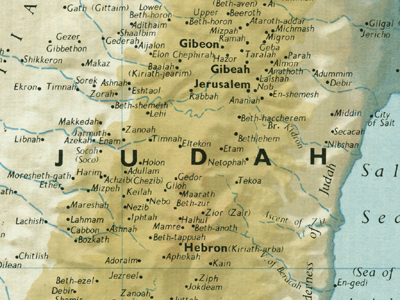
  1. The first twelve verses describe the borders of the promised land that the sons of Judah would inherit, according to their families. Make note of any of the places you find as familiar to you, such as Edom, the Salt Sea, Gilgal, etc.


  2. What area was given to Caleb, son of Jephunneh from the portion allotted to the families of Judah? vs. 13


  3. What was Hebron originally called and why? vs. 13


  4. Who did Caleb drive out from this area? vs. 14 Name the three sons of Anak.


  5. Again, who were the Anakim? Use a concordance and give any information you find.


  6. Who did Caleb come up against after that? vs. 15


  7. What was Debir once called? vs. 15


  8. What did Caleb promise to the one who would attack and capture Kiriath-sepher? vs. 16


  9. Who did this and what was given to him as the reward promised? vs. 17


  10. Once married, what did Caleb's daughter ask for from her father? vs. 18


  11. What was she given for her blessing, other than the land of the Negev? vs. 19


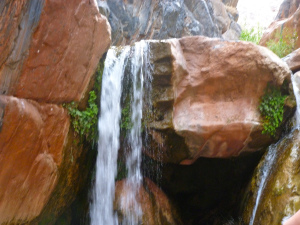
  12. The Negev was a dry land; she wanted a land of springs as well. Not only did he grant her the upper springs, but the lower ones as well. This reminds us of how the Father longs to not only meet us with blessings, but to bless us beyond all we can ask for or imagine. Comment on the following verse:

    Ephesians 3:20


  13. We can also see this as a picture of the Holy Spirit continually filling us. Remember what Jesus said would come out of the believer once He sent the Holy Spirit to indwell us?

    John 7:37-39

    Ephesians 5:18-21


  14. Back to Joshua 15. ... The cities that were part of the inheritance of the tribe of Judah are listed from vs.20-62

    • 29 named (vs.21-32) 
    • 14 named (vs.33-36) 
    • 16 named (vs.38-41) 
    • 9 names (vs.42-44) 
    • 11 named (vs.48-51)
    • 9 more named (vs.52-54) 
    • 10 more (vs.55-57)
    • 6 named and then 2 named (vs.58-60) 
    • 6 named in the wilderness (61-62)

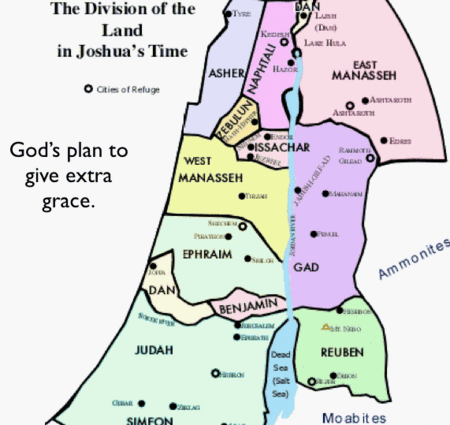
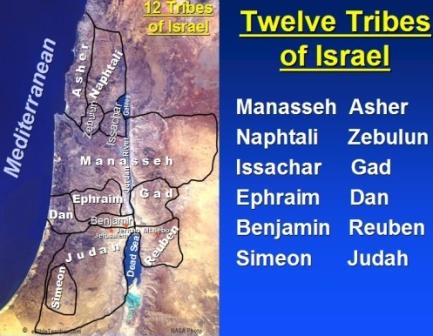
    We won't take time to list all the names of the city, but try to find some of the well known cities mentioned on a Biblical map and get a good sense of how Judah's borders were laid out and the cities that they inherited along with their villages. 


  15. What happened in regard to the city of Jerusalem. Were the inhabitants (the Jebusites) driven out? Why or why not? vs. 63


  16. God had told them to completely destroy all the nations or else they would be a snare to them. He said they would be "thorns in their sides". This is what happens when we fail to conquer an area of the enemy's strongholds in our lives. If we decide to cohabitate with an ungodly habit or some other sin that "easily entangles" us from the race of the Christian life.

    We need to not grow weary in tearing down the strongholds. This war is on for the rest of our lives until we reach the Promise of our Inheritance and finally have that eternal rest of a job well done that has pleased our Father. Comment on the following verses:

    Numbers 33:55,56

    Joshua 23:1-13

    Judges 2:1-3

    Ephesians 4:20-27

    Philippians 3:12-14

    1 Corinthians 6:18-20

    1 Corinthians 9:24-27

    1 Corinthians 10:6-14

    2 Corinthians 10:3-5

    Hebrews 12:1-3


    Application:

     
  17. Please take the time to do the cross references given in the lesson and then commit the things in your heart to the Lord in prayer.


  18. How does being continually filled with God's Spirit and running the race of the Christian life have to do with one another?


  19. Caleb's daughter was not afraid to ask her father for "more". She knew the kind of man he was and she knew he loved her. Will you ask your Heavenly Father for "more" today? What will His answer be to you?

    Matthew 6:33,34

    Matthew 7:7-11

    Matthew 18:18-20

    Luke 11:1-13

    John 14:12-17

    John 16:22-24

    Philippians 4:6,7

    1 John 4:15-19


  20. Summarize the lesson today and post a prayer if you would like. 


Prayer


Father God, I pray ... 


Friday, December 7, 2012

Joshua Worksheet - Chapter 14


JOSHUA 14     


Review: In Chapter 13, we got details concerning the lands that were on the east of the Jordan and how they were given as inheritance by Moses to Reuben, Gad, and the 1/2 tribe of Manesseh.

In Chapter 14, and for several chapters to follow, we will see the description of inheritance for the other 9-1/2 tribes west of the Jordan. In this chapter, we will see Caleb get the inheritance he was promissed because he was faithful to follow the Lord with a whole heart. Lots to glean from that! 

  1. Who are dividing the land of Canaan to the 9-1/2 tribes for an inheritance? vs. 1,2


  2. Who gave the other 2-1/2 tribes their inheritance on the other side of the Jordan? vs. 3


  3. What tribe did not receive an inheritance? vs. 3


  4. Who are the 2 sons of Joseph that are referred to as 1/2 tribes? vs. 4


  5. Although the Levites were not given land as an inheritance, what did all the tribes provide for them to live in within all of their lands? vs. 4,5


  6. What was the first tribe to come forward to learn where their inheritance would be? vs. 6


  7. From the tribe of Judah, who came forth to claim his "own" section of land? vs. 6


  8. Where had the Lord given him His "word" about possessing the land in the land of Promise? vs. 6


  9. How old was Caleb when he was given this promise of inheritance by the Lord? vs. 7


  10. Let's look back at the situation when Caleb received this promise. Read the following Scriptures and questions that follow:

    • Read Numbers Chapters 13.

    • What were they to find out when they spied out the land of promise? vs. 19,20

    • What did they find to bring back to show Moses from the valley of Eshcol? vs. 23

    • When they returned after 40 days, what did they confirm the land was like? vs. 27

    • What negative report did 10 spies give that made the people's hearts melt like wax? vs. 28,29

    • What did Caleb do at that time and what did he say to Moses? vs. 30

    • What did the other men say? vs. 31-33

    • Read Numbers Chapters 14

    • How did all the people react to the negative reports? vs.1-4

    • What did Moses & Aaron do? vs. 5

    • What did Caleb & Joshua do? vs. 6

    • What did Caleb & Joshua say to the people? vs.7-9

    • What did the people want to do to Caleb & Joshua? vs. 10

    • Moses turned to the Lord to intercede for the people for the Lord was so upset with them, He wanted to destroy them and start over again. God said that not one of them 20 years and upward would live to see the Promised Land, but would wander in the wilderness and die off, except for two - Joshua & Caleb - who had believed and had given the correct report to the people. (vs.30)

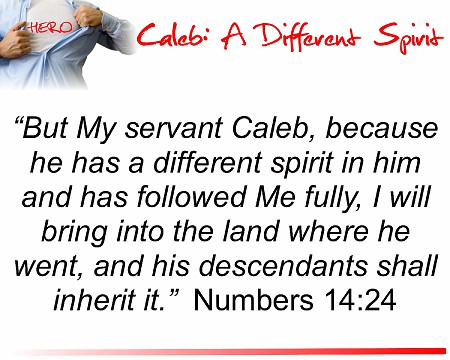
    • What did God recognize about Caleb? vs. 24  


  11. Back to Joshua 14. What does Caleb say about "himself" in regard to following the Lord? vs. 8


  12. What did Moses promise Caleb that day to him and to his children and why? vs. 9


  13. The time had come. It had been 45 years since he had received the promise. How old was Caleb now? vs. 10


  14. What was Caleb's physical condition at this older age? vs. 11


  15. What did he still believe he could handle concerning the land of the giants? vs. 12


  16. What did he still realized was the factor in having victory? vs. 12


  17. What did Joshua bless Caleb with for an inheritance? vs. 13


  18. Again, why did Caleb receive this inheritance? vs. 14


  19. Was was the former name of Hebron and why was it called that? vs. 15


  20. What blessing did the land receive after that? vs. 15


Applications:

  1. Caleb had a different spirit, and a heart that belonged fully to the Lord. He was a man of faith. He took God at His Word. Don't you long for God to say that about your life when we receive our inheritance in heaven? I know I do. Comment on the following verses:

    • What is the Lord searching for even now? 2 Chronicles 16:9

    • Why did the Lord choose young David to be the king over Jerusalem? 1 Samuel 13:14

    • How does God appraise a man's worth? 1 Samuel 16:7

    • How are we suppose to love the Lord? Mark 12:30

    • When facing battles, what should we always remember? Zechariah 4:6,7

    • Caleb was willing to face the mountain put before him with the giants, the fortified cities, and all of it. What did Jesus say we could do about the mountains we face?  Matthew 17:15-20

    • What did Jesus teach his disciples regarding prayer and what did He wonder concerning faith? Luke 18:1-8


  2. In reading Numbers 13, 14 - did you notice how angry the people were with Caleb for being a man of such faith? They wanted to stone him! They would rather have killed Caleb than listen to his words of exhortation that made them feel afraid and uncomfortable!

    Like Caleb, we as faithful followers of God must be prepared to face adversity when we stand for the truth of God’s word. There are those who will oppose us with every fiber of their being before they will submit to God’s will.

    Do we possess the courage of Caleb? Will we stand with God even if means standing alone? If you have time, read Acts Chapter 7 and see why Stephen was killed as the first Christian martyr after the resurrection of Jesus. Share your summary:


  3. So many times, we want to "fit in" with the world's thinking and actions. We can blend in and try to be everyone's friends. We can't be everyone's friends. We need to love them and reach out and share with them, but inevitably it will lead to division, arguments, and yes, hate from them, and we may suffer a lot of harm from them. Let's remind ourselves of how many people will react to our lives as Christians. Comment on the following verses:

    Matthew 5:10

    Matthew 10:22

    Luke 6:22

    Luke 6:27

    John 15:18

    John 17:14

    1 John 3:13

    2 Timothy 3:12

    But, remember that, it is well worth it, for that one person that will finally be hungry and looking and wanting what you are offering them in the Lord Jesus Christ!

    Luke 15:4-10


  4. Even though Caleb was a man of faith and followed the Lord with a whole heart, he had to suffer with the majority who were being judged by the Lord with the current events. Caleb had to wander through the wilderness with the rest of them for 40 years because of their unbelief.

    Many times we are in a hard marriage, or have rebellious children, or whatever the situation might be. Things happen to bring about results in those we live with that might very well have effect on us. Yes, others can cause hardships, even from God, on our household. If a husband gambles away the money and the bills don't get paid, the whole family suffers.

    Rather than react in anger, there are instructions about how we are to display Christ-like character even in the hardest of times. I can just imagine Caleb keeping everyone's spirits up through his faith and positive outlook during those 40 years in the wilderness.

    Let's encourage one another through the following Scriptures. Please comment on each one.

    Hebrews 6:10

    Malachi 3:16

    Psalm 56:8

    Revelation 8:3

    Galatians 6:9

    2 Thessalonians 3:13

    Hebrews 12:3


  5. Summarize the lesson and post a prayer if you would like. 


Prayer


Father God, I pray ...


Monday, December 3, 2012

Joshua Worksheet - Chapter 13


JOSHUA 13     


Review: In Chapter 11, we saw the kings of the north assemble together with their armies against Israel. The Lord gave them victory over them as He did in Chapter 10 with the kingdoms of the south.

In Chapter 12, it is listed the kings and lands that were defeated under Moses (2 kings - Sihon & Og) and the rest defeated under Joshua and all of Israel; a total of 31 kings.

As we move into Chapter 13, we see that Joshua is now old and advanced in age. He has been fighting battles for the Lord and with the Lord for many years now. There was still much land to be possessed.

The Lord gave the inheritance boundaries for those on the east side of the Jordan that Moses had given - Reuben, Gad, and the 1/2 tribe of Manesseh. We will see more distribution of the land from Chapters 14-21. 

  1. What time of Joshua's life was upon him? vs. 1


  2. What still needed to be done? vs. 1


  3. Land still remained to be possessed from the Philistines and the Geshurites (vs. 2) ... the kings of the Philistines, the land of the Canaanites and all of Lebanon (vs.3-5) .... and more ...Who would drive them out from before the sons of Israel? vs. 6


  4. What did He ask Joshua to do beforehand? vs. 6


  5. Who was he to apportion the land to for an inheritance? vs. 7


  6. What about the other 2 and the other half-tribe? vs. 8-12


  7. Who did the sons of Israel "not" dispossess who continued to live among them? vs. 13 - Name 2


  8. The tribe of Levi was not to receive an inheritance. What was the inheritance given them? vs. 14, vs. 33


  9. Moses gave an inheritance to Reuben. (vs.15-23) ... Who did Israel kill during this time? vs.22


  10. Review the lessons on Balaam and state why he is a significant character in the history of Israel. Use a concordance if you need to.


  11. Moses also gave an inheritance to Gad on the east side of the Jordan. (vs.24-28). Some of the places we recognize of his inheritance are the cities of Gilead and half the land of Ammon. He received the rest of King Sihon's kingdom, who was king of Heshbon with the Jordan as a border. 

    When Moses gave the half-tribe of Manasseh their portion (vs.29-31), whose kingdom did he receive and how many cities in all? vs. 30


    Note: Remember "Gilead".  It will be the scene of the battle between Gideon and the Midianites.  It will be the home of the prophet Elijah.  It became famous for its spices and healing balm. 

    Jeremiah 8:22 – "Is there no balm in Gilead? Is there no physician there? Why then is there no healing for the wound of my people?"


  12. Where were theses territories which Moses apportioned beyond the Jordan at Jericho on the east side of the Jordan? 

    In the plains of _______  (vs.32)


  13. Why did Moses not give an inheritance to the tribe of Levi? vs.33 (also vs. 14)


    Applications:

  14. Joshua is advanced in age, and his work is almost complete. The remaining chapters of the book is the legal document of the descriptions of land that the other 9 and 1/2 tribes will receive in the land of promise. 

    We will see once they are all distributed and the people are dwelling securely on the land, Joshua will die at the age of 110. Before he goes to join Moses and others in heaven, he is passing on the responsibilities of the land, the worship, and the commandments to the people so that they will continue to live long on the land. He is preparing them to serve.

    How does this compare to what Jesus said to His own before His death?

    John 12:23-27

    John 13:3-5

    John 13:12-15

    John 13:31-35

    John 14:9-21

    John 14:23-27

    John 15:8-17

    John 16:1-7


  15. What work was to be continued after the resurrection of Jesus before His ascension to the Father?

    Matthew 28:18-20

    Mark 16:11-16

    Luke 24:44-47

    John 21:14-17


  16. We saw in Joshua 13:1 that there was still much land to be possessed that had not been yet. How does this compare to Jesus' statements in the verses below?

    John 4:34,35


  17. Just as the Lord was the one who chose the land and distributed it among the tribes, the Holy Spirit chooses us, dwells in us, and distributes gifts among us for the service of the body of Christ (the church). Comment on the following verses:

    Romans 12:4-13

    1 Corinthians 12:4-11

    Ephesians 4:4-8


  18. Read the parable Jesus gave of the talents in Luke 19.  We have been left with a stewardship over the Lord's kingdom on earth and we each have a portion and a place to serve in it. Wherever we have been planted, we must discover where the Lord wants our service and bloom there.


    Read Luke 19:11-27


    Why did Jesus tell them this parable? vs. 11


    Where did the nobleman go and what did he receive? vs. 12


    How many minas (1 = 100 days' wages) did each of the 10 servants receive from the nobleman? vs. 13


    What did he want them to do with the minas while he was gone? vs. 13


    How did the citizens feel about the nobleman? vs. 14


    What did the majority of the people "not want" the nobleman to do? vs. 14


    What did the nobleman do concerning the 10 servants that were each given a mina when he returned again? vs. 15


    What result did the first servant have for his investment of his mina (gift)? vs. 16


    What did the nobleman (master) say to him? vs. 17


    What result did the second servant have for his investment of his mina (gift)? vs. 18


    What did the master say to him? vs. 19


    Another came up with a handkerchief where he had buried his mina (gift) and gave it back to the nobleman. What was his opinion of the nobleman? vs. 20,21


    What did the master say to him? vs. 22,23


    What did the master tell the bystanders to do? Who got the gift that the person did not want for himself? vs. 24


    How did the bystanders feel about this? vs. 25


    What did the master say about those who have more and do well with them? vs. 26


    What about those who has a gift, but doesn't value it or use it for the kingdom? vs. 26


    What happened to the enemies who did not want him to rule over them? vs. 27


    How can you apply this parable to the free gift of salvation and the gifts that come with it to serve the Lord's kingdom?

    Give your summary thoughts:


  19. Every Christian should be praying to the Lord of the Harvest and be a contributor to the Master's work on earth in sharing the Gospel as well as serving the Church. Where is your place? How can you determine to find out if you do not know. What are your plans for this coming year?


  20. Summarize this lesson and post a prayer if you would.


Prayer


Father God, I pray ...

Sunday, December 2, 2012

Joshua Worksheet - Chapter 12


JOSHUA 12     


Review:  In Chapter 11, the kings of the north assemble together with their armies against Israel. The Lord gives them victory over them as well. In Chapter 12, it is listed the kings and lands that were defeated under Moses (2 Kings - Sihon & Og) and the rest defeated under Joshua and all of Israel; a total of 31 kings. 

  1. Chapter 12 of Joshua lists the kings of the land whom the sons of Israel defeated and the lands they possessed beyond the Jordan toward the sunrise, from the valley of the Arnon as far as Mt. Hermon, and all the Arabah to the east. (Joshua 12:1).  Fill in the blanks, naming the ones that were defeated while Moses was still alive, on the other side of the Jordan:

    vs. 2 - Sihon, king of the __________

    vs. 4 - Og, king of __________


  2. Who were these lands given to at that time under Moses? vs. 6 

    Name 3 tribes


  3. There were 31 kings that Joshua and all Israel defeated beyond the Jordan toward the west, from Baal-gad in the valley of Lebanon even as far as Mt. Halak, which rises toward Seir; and Joshua gave it to the tribes of Israel as a possession according to their divisions (vs 7).

    These were in the hill country, in the lowland, in the Arabah, on the slopes, and in the wilderness, and in the Negev; the Hittite, the Amorite and the Canaanite, the Perizzite, the Hivite and the Jebusite. Name these kings by filling in the blanks below:

    vs. 9 - king of _____; king of _____

    vs. 10 - king of _____; king of _____

    vs. 11 - king of _____; king of _____

    vs. 12 - king of _____; king of _____

    vs. 13 - king of _____; king of _____

    vs. 14 - king of _____; king of _____

    vs. 15 - king of _____; king of _____

    vs. 16 - king of _____; king of _____

    vs. 17 - king of _____; king of _____

    vs. 18 - king of _____; king of _____

    vs. 19 - king of _____; king of _____

    vs. 20 - king of _____; king of _____

    vs. 21 - king of _____; king of _____

    vs. 22 - king of _____; king of _____

    vs. 23 - king of _____; king of _____

    vs. 24 - king of _____


    Applications:

     
  4. Joshua may seem like a "heartless warrior" in these war chapters, but he was an instrument on God's judgments upon the inhabitants of the land. The Lord was patient with the Amorites giving them time to repent as He does in our day.

    Although they did not know the things we know in regard to salvation, Romans 1 teaches that all people have God conscience-ness from creation and an inner witness. Their worship of false gods, human sacrifices, and other wicked (immoral) things was proof that they had denied the Creator to worship the creation. God is fair in His judgment and patient before rendering judgment.

    Comment on the verses below:

    Genesis 15:16

    1 Thessalonians 2:16

    Romans 1:18-25

    1 Peter 3:20

    Romans 2:4

    James 2:13


  5. God also wanted to place Israel at the center of the earth, close to where it all began in the garden of Eden, when He created Adam and Eve. He was judging the idolatry and immorality of the nations, but also giving the nation He created a place to live.

    He created a nation that He would show Himself through to the world, beginning with Abraham, when He called him from the Ur of the Chaldeans. They were aliens without a homeland. God promised them this land, first to Abraham, and described the boundaries exactly as they would be.

    Take time to look up these verses and remind ourselves of His gracious plan for the nation of Israel from the beginning. Also, realize that there were strangers and aliens who traveled among them. Who were they?

    Anyone who wanted to become a part of the Jewish faith was always welcome and therefore would join with them in the temple sacrifices, circumcision, and other matters of the Law of Moses.


    Genesis 11:31 - (Abraham from the Ur of the Chaldeans - modern day area of Iraq)


    Genesis 12:1 - (The Call to go to a land unknown that God would shown him)


    Genesis 12:7 - (Look to east, west, north, south - land I will give your descendants)


    Genesis 13:14-17 - (Abraham was to walk the land and its boundaries)


    Genesis 15:13-21 - (Covenant made with Abraham ../.. - 1st his descendants would be slaves to a nation for 400 years ../.. In the 4th Generation they would go out when the "iniquity of the Amorite was full" - ../.. Specific lands that would be given to Israel at that time (Promised Land) ...


    Jeremiah 13:11 - (Israel's Purpose in the earth)


    Ezekiel 38:1-13 - ( In last days - nations will come against Israel at the center of the earth)


  6. It takes "strength" and "courage" to fully obey the Lord. The phrase "Be strong and courageous" is repeated many times in the book of Joshua. He was obeying the Lord in possessing the land. He had been chosen by God because not only was he a servant to Moses, but a man of faith and willingness to face the enemy.

    This was shown when he was one of the two spies that believed God would give them the land He had promised even in the midst of the giants although the people believed the 10 negative reports and would not go in; thereby wandering in the wilderness for 40 years because of their unbelief.

    There has been a spiritual battle going on between the serpent and the woman's "seed" (the coming Messiah) ever since the world began. What are we told about our spiritual battles the enemy launches on us (the seed of Abraham and Christ by faith) in life today?

    Matthew 4:1

    Matthew 16:18

    Luke 4:13

    John 8:44

    John 13:2

    1 Corinthians 16:13

    Ephesians 4:7

    Ephesians 6:10-14

    1 Timothy 1:18

    1 Timothy 3:7

    1 Timothy 6:12

    2 Timothy 2:3

    2 Timothy 4:7

    2 Thessalonians 2:15

    Revelation 12:10


  7. A time is coming in the future when all of the nations of the world will gather to fight against Israel. Jesus will come with the church and set up His reign on the earth for 1000 years (called the Millenium Reign of Christ). 

    Satan, God's enemy, will be bound for 1000 years. When he is released, he will go out to deceive the nations and come at the city of Jerusalem again, only to be completely destroyed by the Lord at that time.  Jesus the warrior at the great battle of Armaggedon.

    Comment on the verses below:

    Psalm 2:1-12

    Luke 21:24-25

    Ezekiel 39:21-29

    Zechariah 12:1-11

    Revelation 11:18

    Revelation 16:12-16

    Revelation 19:11-21

    Revelation 20:1-10


  8. We don’t have to be afraid. We also can be "strong" and have "courage". Nothing can separate us from the love of God, and through His love, we are more than conquerors!  There is a rest for the believer in knowing that we are in the hand of the Father and no one can take us out!  Finally, like Joshua, we will experience that final rest.

    Comment on the following verses:

    Romans 8:35-39

    John 10:27-30

    John 16:33

    Hebrews 13:6

    I John 4:4

    1 John 5:4

    Revelation 17:12-14


  9. Summarize the lessons and post a prayer if you would like to.


Prayer


Father God, I pray ...

Joshua Worksheet - Chapter 11


JOSHUA 11     


Review:  In Chapter 10, five kings in the area come together to fight against the Gibeonites who had made peace with Israel. Gibeon calls out to Joshua and Israel to help them. They fight the kings and their armies and win over the southern area of the land of promise.

Joshua hangs the five kings and puts stones over them in a heap to mark the victory they had there. They continued to fight with the Lord keeping the sun still in the sky and even helping them with hailstones from heaven.

In Chapter 11, the kings of the north assemble together with their armies against Israel. The Lord gives them victory over them as well. 

  1. When Jabin, king of Hazor, heard of the victories Israel recently had in the area, he got the kings of the north together with all of their armies along with many horses and chariots (vs.1-4).  Where did all of the kings meet up at? vs. 5


  2. What was their purpose in "one accord"? vs. 5


  3. The Lord told Joshua not to be afraid of them. He would slay all of them before Israel on the following day. What did He tell Joshua to do to their horses and their chariots? vs. 6


  4. Where did Joshua and the people of war come upon the kings that had gathered to come against them? vs. 7


  5. What was the result of the battle of these kings that had gathered for war against Israel? vs. 8


  6. What did Joshua do in obedience to the Lord? vs. 9


  7. Joshua turned back at that time and captured Hazor and its king. (vs.10,11) What was Hazor's former position? vs. 10


  8. Joshua captured all the cities of these kings and utterly destroyed them as the Lord had commanded Moses. (vs.12). They did not burn the cities that stood on mounds, except for one. Which city was the exception? vs. 13


  9. What did the sons of Israel take as their plunder from these cities? vs. 14


  10. The Lord had commanded these things of Moses. Moses commanded Joshua before he died. Did Joshua fully obey these commands? vs. 15


  11. Joshua took all that land: the hill country and all the Negev, all that land of Goshen, the lowland, the Arabah, the hill country of Israel and its lowland from Mount Halak, that rises toward Seir, even as far as Baal-gad in the valley of Lebanon at the foot of Mount Hermon (vs.16,17).  He captured their kings and put them to death. (vs.17).  How long did this take? vs. 18


  12. All the cities were taken in battle except for one city that made peace with Israel. What city was that? vs. 19


  13. Who hardened the hearts of these nations to gather against Israel and why? vs. 20


  14. When will kings and nations gather against Israel again in the future?  Armageddon ... Scriptures are given in our application section today, so be sure and look them up.


  15. Back to Joshua 11 ... Then Joshua came at that time and cut off the Anakim from the hill country, from Hebron, from Debir, from Anab and from all the hill country of Judah and from all the hill country of Israel. Joshua utterly destroyed them with their cities. (vs. 21).  What was not left in the land other than some in Gaza, Gath, and Ashdod? vs. 22


  16. Using a concordance, what do you learn about the Anakim?


  17. What did Joshua do with all the land of promise that he had taken in battle? vs. 23


  18. What did the land finally experience? vs. 23


Prayer


Father God, I pray ...